
Teaching and Learning
The Quality of Education is continuously assessed and evaluated at Greenfield Academy. We are using the principles of ‘Engage and Challenge’ across the Academy.
We use a range of strategies for Quality First Teaching to ensure that subject content is not only taught, but that it is regularly re-visited to ensure that disciplinary knowledge is retained and that skills are developed in such a way that they can be applied in different contexts.
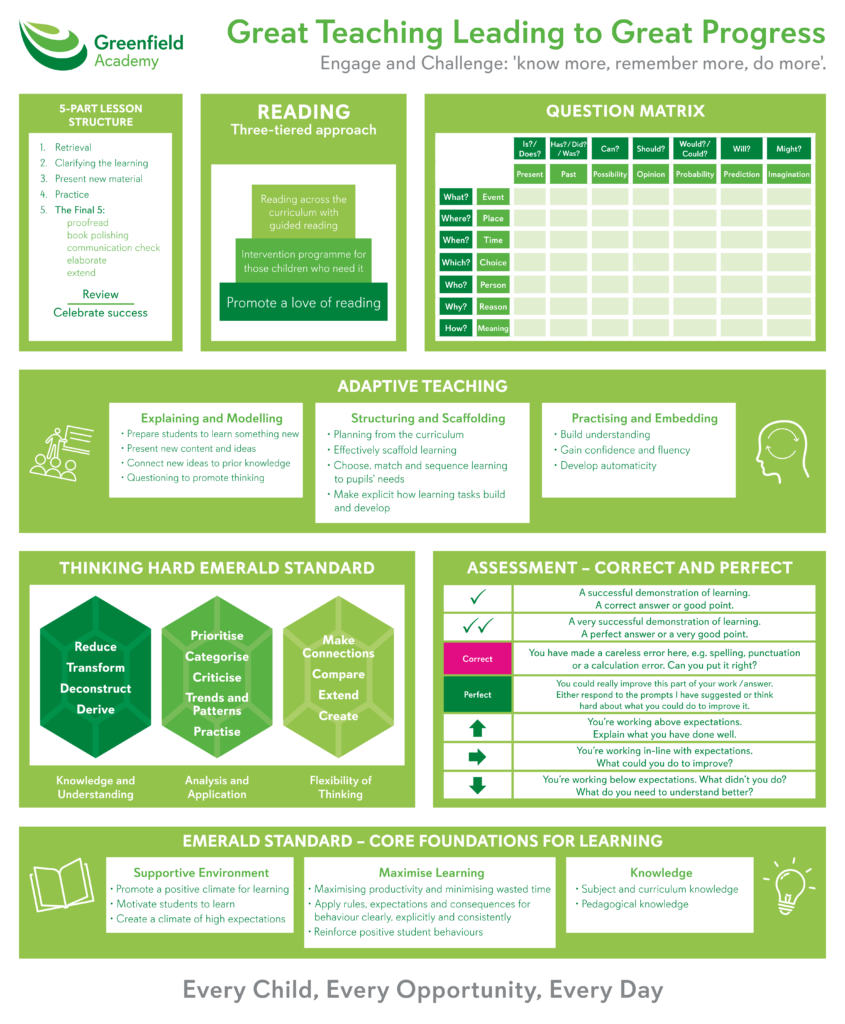
Our Teaching and Learning strategies poster ensure a model for great teaching leading to great progress for every child, every opportunity, every day.
Adaptive Teaching in Our Academy
At Greenfield Academy, we believe in the power of adaptive teaching to meet the diverse needs of our students. Adaptive teaching involves tailoring our instructional strategies to ensure every student can achieve their full potential. Here’s how we implement adaptive teaching through three key phases:
1. Explaining and Modelling
- Prepare students to learn something new: We set the stage for new learning by connecting it to students’ prior knowledge and experiences.
- Present new content and ideas: Clear and concise language is used to introduce new concepts, ensuring all students can follow along.
- Connect new ideas to prior knowledge: We make explicit connections between new content and what students already know, helping them integrate new information.
- Questioning to promote thinking: Thought-provoking questions are posed to encourage deeper understanding and critical thinking.
2. Structuring and Scaffolding
- Planning from the curriculum: Lessons are carefully planned to align with curriculum goals while being flexible to adapt to students’ needs.
- Effectively scaffold learning: We provide support structures that help students gradually build their understanding and skills.
- Choose, match, and sequence learning to pupils’ needs: Learning activities are selected and sequenced to match the varying abilities and learning styles of our students.
- Make explicit how learning tasks build and develop: We clearly explain how each task contributes to overall learning objectives/big questions, helping students see the bigger picture.
3. Practising and Embedding
- Build understanding: Students engage in activities that reinforce their understanding of new concepts.
- Gain confidence and fluency: Repeated practice helps students become more confident and fluent in their skills.
- Develop automaticity: Through consistent practice, students develop the ability to perform tasks automatically, freeing up cognitive resources for more complex learning.
By following these strategies, we ensure that our teaching is responsive to the needs of all students, fostering an inclusive and supportive learning environment. Adaptive teaching is not just a method; it’s a commitment to helping every student succeed.